 Aerodrome finance
 Swaps, Pools, and Voting on Base
Aerodrome finance connects token swaps on Base with liquidity pools and AERO rewards directed through veAERO voting. Traders exchange assets through pool contracts using a compatible wallet. Liquidity providers deposit assets, while eligible staked positions earn emissions of AERO, the protocol token. Locking AERO creates voting power over reward allocation. These activities have different requirements: a successful swap changes wallet balances, a liquidity deposit creates a pool position, and a voting lock commits tokens under its withdrawal rules.
Table of contents
A Base Swap From Wallet Balance to Receipt
Network and Spending Permission
An ordinary self-funded swap requires spendable assets on Base, a compatible wallet connection, and enough ETH on Base to cover network fees. Selecting Base in a wallet changes the network connection; it does not move assets from another chain. The token contract address identifies the asset within that network. Matching a familiar symbol alone cannot establish token identity.
An ERC-20 allowance gives a specified contract permission to spend tokens within an approved limit. Approval and execution are separate operations, even when an interface groups their presentation. The approval request should match the intended token, spending contract, and allowance. The swap request should match the intended input asset, recipient, and minimum output. A successful approval does not mean the swap has happened.
A Swap With a Missing Gas Balance
Consider a hypothetical wallet holding the intended input token on Base, with a supported swap route and sufficient token allowance. With enough gas and an acceptable quote, the wallet can submit the swap. A successful transaction receipt and the corresponding output transfer establish completion.
If that same hypothetical wallet lacks gas, its token balance cannot fund an ordinary self-funded transaction. Fund the wallet with ETH on Base before submitting. Increasing slippage cannot repair this dependency. If funding is unavailable, stop before signing; the input tokens remain unswapped.
What Changes the Amount a Swap Returns?
A swap's output depends on its input amount, available liquidity, route, pool fees, and the pool state when execution occurs. Price impact describes the effect of the trade itself on pool pricing. Slippage describes the difference between the quoted outcome and execution. A larger trade relative to available liquidity generally moves the price further.
The minimum output sets a transaction boundary. If execution cannot satisfy that boundary, the swap reverts rather than delivering less through that call. A reverted transaction can still consume network fees. Raising the tolerance accepts a worse possible execution price; it does not add liquidity or reduce the pool's fee.
Pool fees and network fees cover different costs. Base network charges include execution and the cost associated with publishing transaction data to Ethereum. Pool fee settings can differ across deployments and pools, so a single percentage cannot describe every Aerodrome swap. The relevant comparison uses the executable output and the separate transaction cost.
Pool Design and Active Liquidity
A liquidity position supplies assets for swaps, and its pool design determines how those assets participate across prices. Aerodrome supports classic stable and volatile pools alongside Slipstream concentrated liquidity. The choice changes capital allocation and maintenance requirements.
Stable Pools and Correlated Prices
Stable pools use a pricing curve intended for assets whose prices remain closely related. The curve supports trading near that relationship with less price movement than a comparable volatile pool. Correlation remains an economic assumption. The pool cannot force an asset to maintain its peg or prevent losses when that relationship breaks.
Volatile Pools and Changing Reserves
Classic volatile pools use constant-product pricing. Swaps change the balance between the pooled assets, which changes the marginal exchange rate. Liquidity providers hold a claim on the pool's changing reserves. Their eventual asset mix can differ from their deposit, and its value can underperform simply holding the original tokens.
Slipstream and Selected Price Ranges
Slipstream positions allocate liquidity within selected price ranges. Narrower ranges concentrate capital around fewer prices, increasing exposure to movements beyond those boundaries. An out-of-range position no longer supplies active liquidity for trades at the current price. It also stops accruing the emissions reserved for active staked liquidity. Adjusting an unlocked position's range requires another liquidity operation and incurs transaction costs.
How Do Staking Rewards Differ From Swap Fees?
Staking an eligible liquidity position exchanges its direct swap-fee earnings for AERO emissions distributed through a gauge, the pool's reward contract. The forgone swap fees go to pool voters. An unstaked position follows the fee-earning path instead. For Slipstream, an applicable unstaked-liquidity fee can reduce the fees the provider collects. Neither path establishes a fixed return.
A gauge distributes AERO emissions to eligible staked liquidity positions. Pool creation alone does not establish staking eligibility. The pool needs an associated live gauge, and the position must meet that gauge's requirements. Concentrated positions also depend on price range activity. Voting allocations and applicable gauge caps influence the rewards available to distribute.
A displayed annual percentage rate extrapolates inputs that change, including emissions, token valuation, and competing liquidity. It does not describe a guaranteed increase in the deposit's value. Newer Slipstream gauge implementations also support configurable minimum stake durations and reward penalties for early claims or withdrawals. Those conditions belong to the particular gauge; they are not a universal waiting period.
What Does Locking AERO Give You?
Locking AERO creates a veAERO position with voting power, allowing its holder to influence pool emissions and participate in associated voting rewards.
A veAERO position represents locked AERO through an ERC-721 NFT. Ordinary timed locks derive voting power from the locked amount and remaining duration. Their voting weight declines as expiry approaches. The maximum lock duration is four years, while permanent locks maintain voting power without that time decay. Disabling permanent mode requires no active pool vote and starts a new four-year timed lock, rounded down to a weekly boundary. AERO remains locked until that expiry.
Pool voting operates in weekly epochs. A position's allocation helps direct emissions, while its share of votes for a pool determines its share of the relevant voting rewards. Projects can deposit voter incentives to attract allocations toward their pools. That incentive does not guarantee trading demand, asset quality, or profitable liquidity provision.
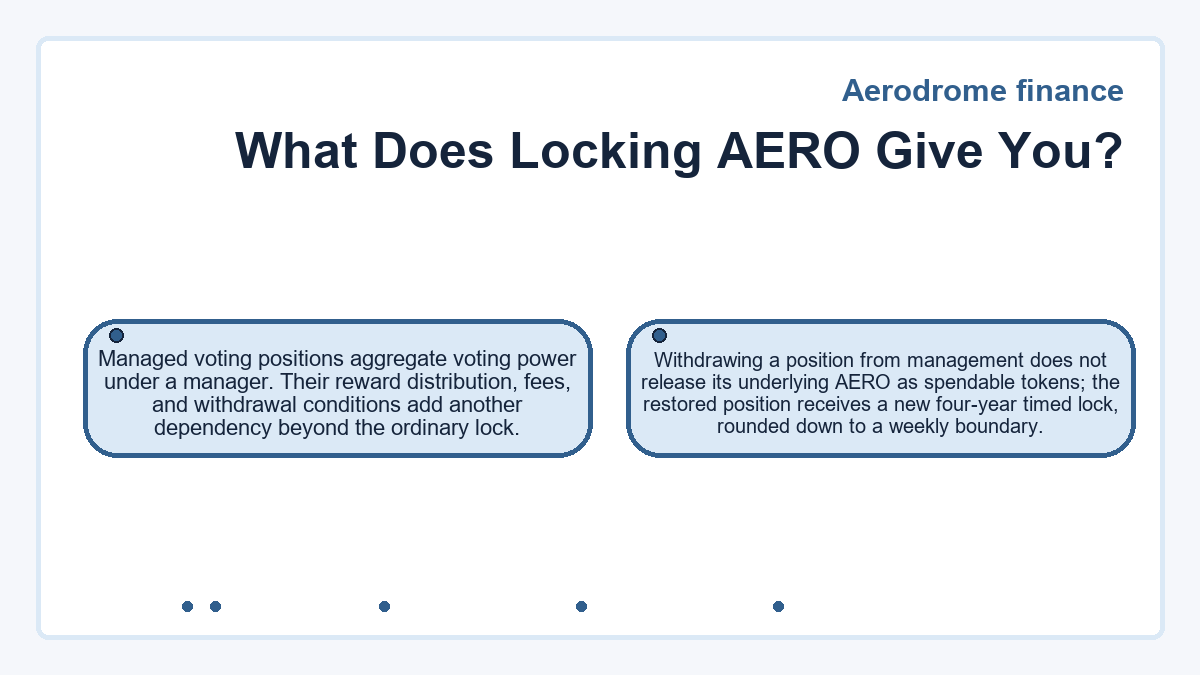
Managed voting positions aggregate voting power under a manager. Their reward distribution, fees, and withdrawal conditions add another dependency beyond the ordinary lock. Withdrawing a position from management does not release its underlying AERO as spendable tokens; the restored position receives a new four-year timed lock, rounded down to a weekly boundary.
Aero Launch and Liquidity Locks
Aero Launch supports creating a token's liquidity market, including pool selection, initial pricing, range selection, and optional liquidity locking. A locked deposit permits additional liquidity but prevents withdrawals and range changes until its expiry. Staking remains conditional on reward availability. Becoming eligible for staking does not remove an existing liquidity lock. After expiry, the owner can unlock the deposit for ordinary management.
Withdrawal Rights and Remaining Exposure
Removing liquidity changes the form of exposure: the provider receives the assets represented by the position at withdrawal. Unstaking alone leaves the liquidity position intact. A swap, liquidity withdrawal, and voting-lock expiry therefore produce different outcomes. Claiming rewards does not itself withdraw liquidity or unlock AERO.
Wallet permissions can persist after a transaction. Disconnecting an interface does not revoke a token allowance, and revocation cannot reverse a completed transfer. This matters because an interface can request harmful permissions without any failure in the pool contracts. Permission scope, contract behavior, and market exposure are separate risks. The distinction also applies to NFTs: a Slipstream liquidity position and a veAERO voting lock represent different assets and withdrawal rights.
Aerodrome finance FAQ
Do I Need AERO to Pay for an Aerodrome Swap?
AERO is not Base's native gas token; ordinary self-funded transactions pay network fees in ETH on Base. Holding AERO matters when it is the asset involved in an operation or when creating a voting lock. It is not a general membership requirement for exchanging other supported assets.
Does an Aerodrome Swap Move Tokens to Another Blockchain?
A pool swap on Base exchanges assets on Base rather than completing a transfer to another blockchain. Moving the resulting assets elsewhere requires a separate transfer mechanism with support for the destination network and asset. A destination wallet address alone does not establish that compatibility.
Why Can a Token Appear in a Pool Without Being Trustworthy?
Permissionless pool creation does not certify a token's issuer, transfer behavior, or economic value. A token can imitate another asset's name or symbol. Its contract can also impose transfer restrictions that affect buying, selling, or withdrawing. Pool availability and eligibility for protocol rewards are different properties.
Can a single-token Deposit Work With Every Token?
Aerodrome's classic router zapping functionality does not support every token behavior. Zapping converts an input into the assets needed for a liquidity deposit, but its support excludes fee-on-transfer tokens. The existence of separate router functions for some fee-on-transfer swaps does not make those tokens compatible with zapping.
When Can a veAERO Holder Change a Pool Vote?
A veAERO holder who has voted must wait until a later weekly epoch to change the allocation. Ordinary positions can vote once per epoch, outside its first and last hour. Only specially approved NFTs can vote during the last hour. Managed-position actions introduce additional restrictions, including conflicts between voting and depositing into management during the same epoch.
— updated